How Long Should a Blog Post Be in 2026? Every Study, Dated and Sourced

On November 19, 2026 I searched Google for “how long should a blog post be” through a search-data service, with US, English and desktop settings. The AI Overview, the AI-written answer Google shows above the results, said 1,500 to 2,500 words and listed eight sources. I counted the words on nine pages from that search, four cited in the AI Overview and five among the regular results, and only three of the nine say how many pages, posts or queries any of their numbers rest on.
I work at RankControl, an AI SEO and AEO platform, where SEO means search engine optimization and AEO means answer engine optimization, which is getting pages quoted in AI answers. RankControl published its own guide on November 22, 2026, How Long Should A Blog Post Be In 2026? What Ranks And Gets Cited. This post is the list I wanted that morning: 11 studies on blog post length that I could trace, each with who ran it, the date on its page, the sample, what it measured and what it found. I re-opened every page on November 19, so each figure comes from the page itself, and two more studies that I could not check are covered after the tables.
The short version: no study in this list shows that word count alone moves a page up Google. Backlinko’s 11.8 million Google results put the top-10 average at 1,447 words and found no direct relationship between length and rank, and Ahrefs counted 174,048 pages cited in Google’s AI Overviews, 53.4% of them under 1,000 words. The studies that did reward length measured traffic, page views or links across pages that happened to be long: HubSpot’s 6,192 posts, Semrush’s 138% more page views for posts of 3,000 words or more, and Backlinko’s 77.2% more referring domains (separate sites linking to a post) across 912 million posts.
How we checked
What I checked. I opened the page behind every study, quote and number in this post and looked for the figure in the page’s own text. For the nine-page count, I pulled Google’s results for the question through DataForSEO, a search-data service, at 14:44 UTC on November 19 (US, English, desktop, top 10 plus the AI Overview). I saved the AI Overview’s eight source links, followed Google’s redirect links to the real address of each regular result, downloaded the pages and counted the words in each article. I also read two Reddit threads through the AgntData API.
When. Everything dated November 19, 2026 is mine, and every study keeps its own date in the tables below.
Sample. Eleven studies, four Google and John Mueller pages, nine counted pages and two Reddit threads. A tenth page from the search, RedSEO’s article, loaded but its text sits in blocks my counter could not read, so I describe it and leave it out of the counts.
Limits. Didn’t re-do any study. Orbit Media: they serve bot check to curl and Chrome so I grabbed data off Internet Archive’s copy of the page (from November 16, 2026). Search Engine Land: curl gives me HTTP 403. Loads in Chrome. Copy-pasted the article text. Kevin Indig’s memo from March 23, 2026 is paywalled.
The same question run twice more within a minute under other settings returned different lists, so the nine pages are one snapshot. My word counts also depend on where an article starts and ends: two passes over the same saved pages differed by up to 584 words, which I come back to under Mueller’s 2025 comment.
Every blog post length study, with its date
Most advice on length seems based on a few studies. In them different things were measured on different samples at different times and they are all combined into one number that’s not in any of them. Here’s each row: study, date on the study page, sample, what was measured, what they found.
Studies of Google rankings, traffic and links
| Study | Date on its page | Sample | What it measured | What it found |
|---|---|---|---|---|
| Backlinko, search ranking study | Page last updated April 14, 2025 | 11.8 million Google results | Word count against rank | Top-10 average of 1,447 words and no direct relationship between word count and rank |
| Backlinko with BuzzSumo, content study | February 19, 2019 | 912 million blog posts | Length against referring domains and social shares | Posts over 3,000 words had 77.2% more referring domains than posts under 1,000; posts of 1,000 to 2,000 words had 56.1% more social shares than posts under 1,000, with diminishing returns after 2,000 |
| HubSpot, shareable and linkable post study | Page updated June 5, 2025; organic visits counted May 1 to July 31, 2015 | 6,192 posts on HubSpot’s own marketing blog | Length against organic traffic, shares and links | 2,250 to 2,500 words earned the most organic traffic; posts over 2,500 words got the most shares and the most links; HubSpot calls it a correlation study |
| Semrush, data-driven length guide | September 28, 2022 | Not stated on the page; it cites Semrush’s State of Content Marketing Global Report 2022 | Length against page views | Posts of 3,000+ words got 138% more page views than posts under 500 words |
| Semrush, blogging statistics | Page dated May 6, 2024; figures labeled 2023 | Not stated on the page | Length of top-performing against low-performing posts | Top-performing posts averaged 1,152 words and low-performing posts 668; over 30% of marketers called short articles their best-performing content and 24% said long-form posts |
| Orbit Media, 2026 blogging survey | September 8, 2026 | 1,042 content marketers, 13th year of the survey | Self-reported post length and results | Average post of 1,312 words, down from a 2023 peak of 1,427; 6+ hours on 2,000-word posts roughly doubled the odds of strong results; 13.9% said their blog delivers strong results, an all-time low |
| SerpIQ, “How Important is Content Length?” (archived copy) | April 26, 2012 | Not stated in the text; “all of the SERPs we’ve analyzed” | Average length by result position | Tenth-position pages carried about 400 fewer words than first-position pages; at least 1,500 words called a good target for most results |
The biggest sample set is from Backlinko’s ranking study. They see that longer content is generally better for link building and can get you into the first page, but doesn’t really do anything for you once you’re in the first page. In 2019 they did a study with a content data service, BuzzSumo, and saw 94% of all blog posts have 0 external links which helps to put 77.2% into context. The 77.2% is links for posts of 3,000+ words. The 56.1% is shares for posts of 1,000 to 2,000 words. Those two percentages are different length bands.
HubSpot’s author, Matthew Howells-Barby, says the study was purely about finding correlation, so it offers no absolute answer on what causes traffic, links or shares. It also found that posts under 250 words got more shares than other posts under 1,000 words. Semrush’s guide, by Margarita Loktionova, gives its own example for the keyword “how to scale a startup”: the top result ran 1,997 words, the second 554 and the third over 3,200. Both companies sell marketing software, and both pages sit on their own blogs.
Only Orbit has this survey that shows how length has changed over the years. They claim on their page that average length increased from 800 to over 1200 words at some point in the past (no years in the quote I received), hit 1427 in 2023, and was 1312 in 2026. The 6+ hours result sounds like a vote for length, but these are self-ratings from those who answered, and their page claims that for more work marketers have less predictable results than they used to (via Orbit).
Studies of AI answers
| Study | Date on its page | Sample | What it measured | What it found |
|---|---|---|---|---|
| Ahrefs, AI Overviews length study | December 3, 2025 | 560,346 AI Overviews, 1,677,876 cited URLs, 174,048 pages with readable text | Page length against being cited and citation position | Cited pages averaged 1,282 words; 53.4% were under 1,000 words; the correlation with citation position was 0.04 |
| Kevin Indig, reported by Search Engine Land | February 18, 2026 | 1.2 million AI answers, 18,012 verified ChatGPT citations | Where on a page ChatGPT cites | 44.2% of citations came from the first 30% of a page, 31.1% from the middle and 24.7% from the last third |
| Chen and Koudas, University of Toronto | October 10, 2026 | 158,099 AI answers with 468,037 citations; the page-level model covers 12,038 pages on 1,120 websites | Page features, including word count, against citations | Word count went with 0.9% more citations per standard deviation of length, and the paper says length shows no effect |
| DEJAN AI, “How big are Google’s grounding chunks?” | December 20, 2025 | 7,060 queries, 2,275 pages, 883,262 snippets | How much of a page Google’s AI uses | A fixed budget of about 2,000 words per query and a plateau at about 540 words per page; the share of a page selected was 61% for pages under 1,000 words and 13% for pages over 3,000 |
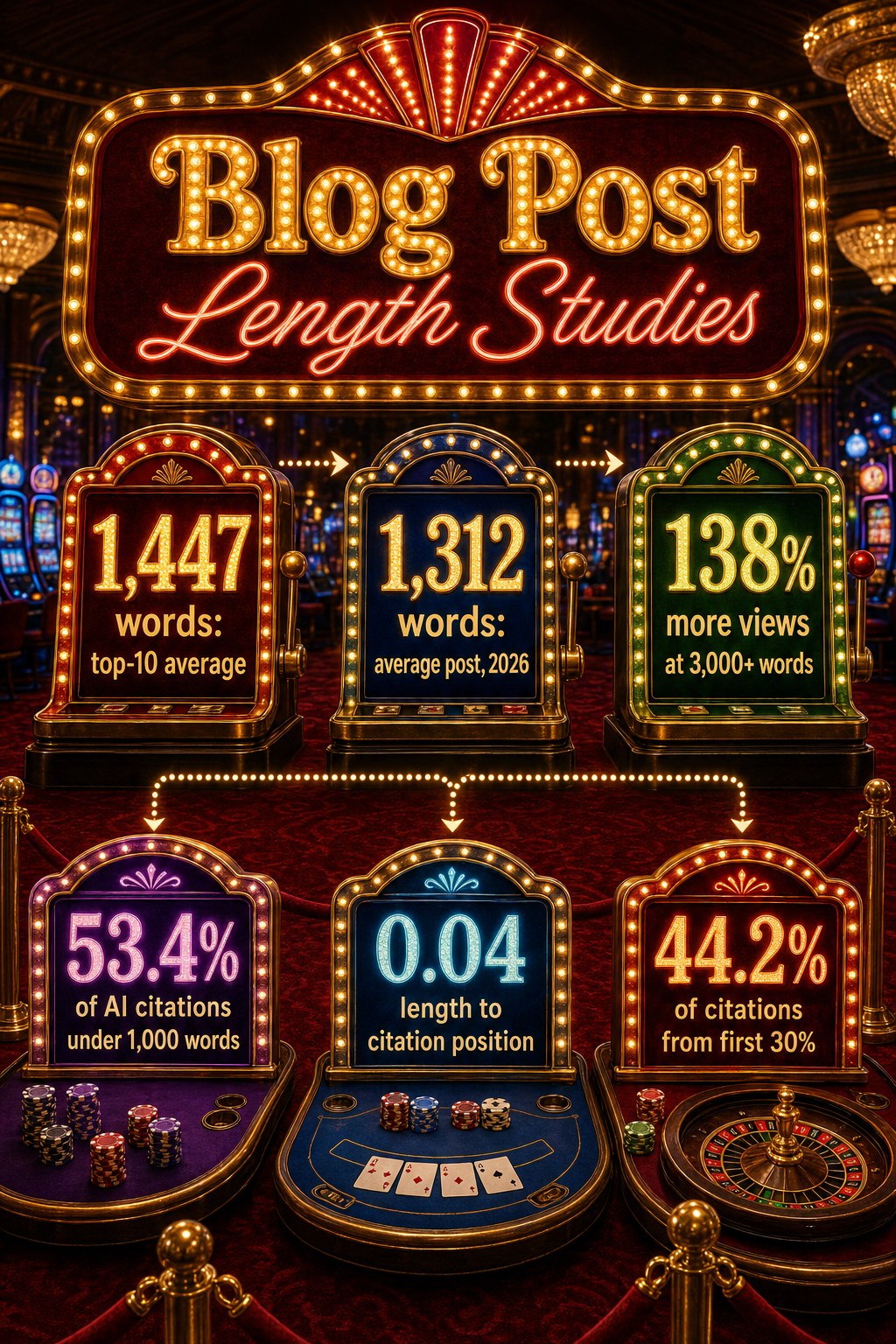
Figures from the studies above, re-opened on November 19, 2026.
Despina Gavoyannis at Ahrefs started from 560,346 AI Overviews and kept the 174,048 cited pages whose text Ahrefs could read. Cited pages averaged 1,282 words, against 1,188 for pages ranking in Google’s organic results. The split ran 16.6% under 350 words, 36.8% from 350 to 1,000, 30.6% from 1,000 to 2,000 and 16.0% over 2,000, and the longest blog post cited was about 3,500 words. The correlation between word count and citation position was 0.04 (0 means no relationship and 1 a perfect one), with position 1 averaging 1,270 words against 1,690 for positions 4 to 10.
Gavoyannis writes that if most sites published 10,000-word guides, those 10,000-word guides would be cited, not because they’re 10,000-words, but because they’re the ones out there. So I take this as a warning on the 53.4%, which indicates that short pages aren’t being held back. And it doesn’t indicate that AI Overviews are favoring short ones because there’s no way of knowing how many short/long pages they’re counting.
Kevin Indig (growth advisor) was measuring position, not length. 44.2% of 18,012 (verified citations) came from the first 30% of the page. Danny Goodwin reported in Search Engine Land on February 18, 2026. 31.1% was in the middle (30-70%). 24.7% was from the last 30%. 53% were in the middle of the paragraphs. 24.5% were from the first sentences. 22.5% were from the last sentences. If your best answer is in the last third of a long post, that’s writing with only a quarter of the citations.
Toronto’s paper is actually directly measuring length as one of the 14 page features in their Table 2. Mahe Chen and Nick Koudas looked at the trajectories of ChatGPT, Gemini and Perplexity responses for two different 90-day data runs. They found pages with the best-fitting paragraph (compared to the pages within the same website) to the popular questions had 15.5% higher citation per std dev (typical page to page difference) and the title match had 14.1%.
Word count got 0.9% and passed 1 of the paper’s 5 robustness tests, and when the pages were compared at the same rank in ChatGPT’s own result lists, each extra standard deviation of length multiplied the odds of a citation by 0.59, so shorter pages were cited more.
The big takeaway from the paper is about retrieval (the part of ChatGPT’s own search process that determines what pages it looks at). Page attributes like FAQ boxes, structured data, summary boxes, author boxes, page speed could explain 2.8% of the variation in how often the pages from the same website were cited by ChatGPT. The variation in which pages are retrieved by ChatGPT’s search could explain 32% of the variation. It also diminishes as we see the portion of the variation shared between two windows of collection decrease to 14% for ChatGPT, 29% for Gemini and 0% for Perplexity after 10 weeks.
DEJAN AI, an Aussie AI SEO agency, did the oddest length study, in a December 20, 2025 post saying that Google’s Gemini-powered AI selects a median of 377 words from a page. They further say that the percentage of a page selected drops from 61% for under 1,000 words, to 35% for 1,000-2,000 words, to 22% for 2,000-3,000 words, to 13% for more than that. They don’t post their data (one comment on the page from a reader does point that out).
Studies I could not check
I found 2 more that I couldn’t validate: Kevin Indig’s Growth Memo of March 23, 2026 “The science of how AI picks its sources” (from public summary: more than 21,000 citations analysed to understand impact of content length, depth and focus), but paywalled results, didn’t subscribe.
Visionary (UK SEO agency) made a page in April 2026 about a crawl of 100000 pages in the top rankings for 5000 keywords. On their page they show that avg. wordcount for a #1 page is 2140. And that raw wordcount has a correlation of 0.18 with ranking. They only send out complete data on email request so I’ve skipped them in the tables.
Why the studies seem to disagree
According to Backlinko’s 2019 article, longer content generally gets more links, and links improve rank. So long content seems to be the cool passenger for the hard-working links. Backlinko’s data (from 2019 page) implies that at least part of the long-content-generally-ranking story has to do with backlinks. On one blog during one summer, HubSpot found that their longest posts got the most traffic. But when looking at 11.8 million results, Backlinko found no direct correlation between length and position beyond first-page inclusion.
Yep, the same numbers hide effort. 2,500 words on a post? Probably means a lot more time researching, more time editing. Plus the author finishing it. Orbit’s 6+ hours finding is about time spent, as much as anything. And another factor which is hidden in SerpIQ’s 2012 post. They found around 1800 words on the ranking pages for domains less than a year old. 2100 for 1 to 10 years old. 2800 for over 10 years old. And, their counts include the sidebars.
None of these studies took one page and made it longer. They compare different pages that happen to be long or short, and even the Toronto paper compares different pages on the same site. So the data supports “long posts often do well” far more than “make this post longer”.
Put the ranking studies next to the AI studies and they split. On Google rankings and links, length travels with the 77.2% more referring domains and the 2,250 to 2,500 word traffic peak. In AI citations it barely registers, at 0.04 in Ahrefs’ 174,048 pages and 0.9% in the Toronto paper, while the Indig, DEJAN and Toronto results point at where an answer sits and whether a passage matches the question.
What Google says about word count
Google’s page on creating helpful, people-first content, last updated October 5, 2026, lists signs that content is written for search engines first. One of them asks whether you are writing to a particular word count because you heard Google has a preferred one, and the answer printed in brackets is “(No, we don’t.)” On November 19 I opened that page and the sentence was still there.
John Mueller of Google has said the same thing three times that I could date.
| Date | Where | What Mueller said |
|---|---|---|
| August 5, 2019 | A Reddit thread, reported by Search Engine Roundtable | “Word count is not a ranking factor.” |
| February 27, 2021 | A video answer, reported by Search Engine Journal | Word count is neither a quality factor nor a ranking factor, and adding text blindly does not make a page better |
| January 21, 2025 | Bluesky, reported by Search Engine Roundtable | “word-count itself makes so little sense” |
The 2025 comment was in response to screenshots of SEO tools that provided different word counts for the same page. I saw it too as the first time I went through the saved pages it came out 2232 words for Optuno’s page and then on the second pass (after getting rid of the sidebar and related posts) it was 1648 and for AwardSpace it was 1830 words first and 1419 words second time.
If different tools disagree on the length of one page, then a ranking scheme that’s based on length will give a different ranking to a page depending on which counts it. SerpIQ’s 2012 post cautioned against this with their inclusion of sidebar text in counts. (Mueller’s words are spoken or posted comments; these are less weight than Google’s written page. But the written page and three comments agree across 2019-2026.)
What nine pages Google shows for the question
The question that Google AI Overview answered on November 19, was the one from the title of this post. I did a count on the pages it cites vs. the regular results next to it. In the AI Overview, it started at 1,500 to 2,500 words. Then it had ranges for types of post (quick answers 300 to 600 words. How-to 1,700 to 2,500. Pillar 3,000+ words). 8 sources. Google’s snippet dates on the regular results range from April 6, 2015 to November 16, 2026.
| Page | Where it showed | Words counted | Figure it recommends | What backs the figure |
|---|---|---|---|---|
| Wix Blog, “How long should a blog post be for maximum impact?” | AI Overview source | 3,619 | 1,500 to 2,500, with a sweet spot at 2,450 | Wix Blog’s own results around 2,450 words, no sample given |
| Lovable guide, “Data-Backed Guide 2026” | AI Overview source | 1,734 | 1,500 to 2,500 | Links to Backlinko (11.8 million results, 912 million posts), Orbit, Semrush and Ahrefs (174,000 pages) |
| The Write Practice, “A Writer’s Guide” | AI Overview source | 1,905 | 2,450+ for Google traffic | A link labeled “the data” to a Quick Sprout article |
| 11content, “In 2024? (Backed By Research)” | AI Overview source | 1,561 | 2,566 to 2,736 | Its own count of the top 10 blogs in each of five niches |
| Capsicum Mediaworks, updated April 1, 2026 | Regular result | 9,242 | 2,000 to 2,500+ | A chart of top-10 positions (2,400+ first, 2,300+ fifth, 2,000+ tenth) with no study named |
| AwardSpace, snippet dated September 29, 2025 | Regular result | 1,419 | 1,200 to 1,800 for how-tos, about 2,000 for pillar posts | Cites WG Content and Elementor, which gives a 1,890-word sweet spot |
| Social Media Today, April 6, 2015 | Regular result | 1,852 | No target of its own; quotes 1,500 to 1,600 from older sources | Medium’s December 2013 finding on seven-minute posts (1,600 words), SerpIQ’s April 2012 post and Buffer’s 1,600-word guideline |
| Page One Power, snippet dated August 18, 2023 | Regular result | 1,244 | 1,000 to 2,500 | Numbered links to Search Engine Journal, Semrush and HubSpot pages, no dated study in the text |
| Optuno, November 16, 2026 | Regular result | 1,648 | A few hundred words for narrow questions, 1,000 to 1,500 for how-tos, 2,000+ for broad guides | Names DEJAN AI’s December 2025 analysis of 7,060 queries and 2,275 pages |
Median word count for the nine is 1,734. Seven of the nine are 1244 to 1905. Wix and Capsicum Mediaworks are 3619 and 9242, raising the average to 2692. The title on 4 pages suggests a target greater than 2000 words, Wix 2450, Capsicum Mediaworks 2000 to 2500+, The Write Practice 2450+ and 11content 2566 to 2736. Of those 4, two are less than the recommended number. The Write Practice is 1905, vs. recommended 2450+ and 11content 1561 vs. 2566 to 2736.
Three of the nine, Lovable, 11content and Optuno, state a sample size for at least one number. The other six give a bare number, a chart with no label, a link whose anchor text is “the data” or a list of older sources. The remaining regular results were a Facebook group post, a Quora thread and a Blue Archer article about how long it takes to write a post, so I did not count them, and RedSEO’s page lists 1,500 to 2,500 words for longer posts and 300 to 600 for short ones.
Numbers that circulate without a study behind them
The oldest figure still in circulation is SerpIQ’s. On October 27, 2025 a commenter in an r/Blogging thread quoted it as 2,416 words for the first result and 2,032 for the tenth, calling it a little dated. SerpIQ was a rank-tracking tool, and on November 19 its blog domain no longer resolved. The Internet Archive holds a copy of the post dated April 26, 2012, which says tenth-position pages carry about 400 fewer words than first-position pages. The 2,416 and 2,032 figures are not in its text, though they may sit in the chart image, which I cannot read as text, and their gap of 384 words is consistent with the 400.
Wix’s guide shows how a number drifts. It says quality beats length and that a focused 800-word post can beat a rambling 2,000-word one, then names 2,450 words as the sweet spot a few paragraphs later. It also says long-form content of 1,000 to 2,000 words generates 77% more backlinks and 56% more social shares than content under 1,000 words. Backlinko’s 2019 page gives the 77.2% for posts over 3,000 words and the 56.1% for posts of 1,000 to 2,000 words, so the Wix sentence merges two findings into one band.
Lovable’s guide says Orbit’s survey “landed at similar figures around 1,427 words”, but 1,427 is Orbit’s 2023 peak, and Orbit’s 2026 page gives 1,312. I searched Backlinko’s 11.8 million results page for 1,890 and found nothing. The only place that figure turned up in my nine pages was AwardSpace, which credits Elementor for a sweet spot around the 1,890-word mark. A cited number is not the same as a sourced one, and the tables above hold the ones with a date and a sample behind them.
What bloggers say on Reddit
On October 27, 2025 someone in r/Blogging wrote that forcing 2,000-word posts because long form ranks better was “killing my soul”, and said half of each post was filler (37 upvotes and 49 comments when I read it on November 19). The reply I found most useful did not give a number. It said to check what kind of content ranks for the topic, long or short, and decide from there.
Another commenter said they write 800 to 3,000 words depending on the topic and went from about 800 monthly visitors in January to a likely 6,000 by the end of October, which is one blog and proves little, but that blog grew while each topic set its own length.
In r/b2bmarketing, a thread from April 29, 2026 (7 upvotes and 16 comments) asked whether 3,000-word posts are dead. The poster called word count as a north-star metric bollocks, quoted the line they attributed to Mark Twain about not having time to write a short letter, and asked writers to judge value per sentence instead. One reply said that length stopped being the advantage and clarity took its place now that AI summarizes everything. Another reply said 3,000-word posts are not dead and fluffy ones are, and that a topic needing 600 words should stop at 600.
Ranges people publish
Here are the ranges reported by 3 different sources for post types (on November 19, 2026). These are guidance, not a result from the above studies.
| Post type | Semrush guide, September 28, 2022 | Mailchimp guide, undated page | Google AI Overview, November 19, 2026 |
|---|---|---|---|
| Any post, general rule | About 1,500 to 2,500 | 1,500 to 2,000 | 1,500 to 2,500 |
| Announcement or news | 400 to 600 for announcements, 600 to 1,000 for news | 400 to 700 for simple press releases and announcements | 300 to 600 for quick answers and news updates, 600 to 1,000 for standard posts |
| Informational or “what is” post | 1,000 to 1,500 | 1,000 to 2,500 for informational posts and how-tos together | 1,300 to 1,700 |
| Guide, how-to or listicle | 1,500 to 2,500 | 1,000 to 2,500 for informational posts and how-tos together | 1,700 to 2,500 |
| Pillar page | 3,000+ | Over 3,000 | 3,000+ |
Google’s own page, Semrush’s guide and Ahrefs’ study end up in the same place on method. Google’s page lists writing to a word count as a warning sign, Semrush’s page says to Google the keyword and analyze the content ranking on page one, and Ahrefs says to let the topic and format set the length.
What that actually means in practice is that you’re going to go search that exact keyword. Look at the top 5 organic results (not the AI Overview). Then see what page type is winning, and how long are these pages and what questions are they answering. RankControl would say if it’s a 3000 word guide in the top 5, you’re probably not going to meet that search with a 600 word post. If it’s short answers in the top 5, you might be wasting your time with a 3000 word post.
How RankControl handles length
RankControl’s content engine writes 1,500 to 4,000+ word articles in your brand’s voice, based on the pages already ranking, and then publishes each one as a native post on your own site, so each article’s length follows what ranks for its keyword. The page’s FAQ adds that the format sets the default, at 1,500 to 3,500 words for guides and 800 to 1,500 for explainers, and that any single article can override it. RankControl then checks weekly whether those pages are cited by seven AI engines: ChatGPT, Perplexity, Claude, Gemini, Grok, Google AI Mode and Google AI Overviews. RankControl costs $400 a month, or $4,000 a year; one plan with a 7-day free trial.
Sure, you can do it manually for every post. RankControl’s opinion is that it’s not hard to write one post and make it of the right length, but what’s hard is to observe pages around and notice when it goes out of place.